


If you regularly get mouth ulcers (canker sores), you've probably tried to find an explanation. Was it something you ate? Stress? A vitamin deficiency? Or that accidental bite?
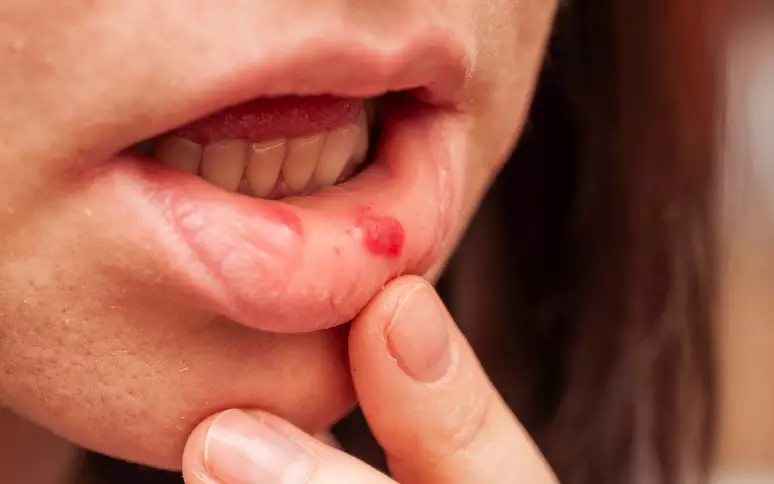
The truth is that mouth ulcers usually don't have a single cause. They tend to appear when someone with a predisposition is exposed to a trigger that causes inflammation in the oral mucosa. Most of the time, the lesion heals on its own within two weeks. The problem is when they become frequent or don't follow that pattern.
Can biting your mouth cause an ulcer?
It can be one of the triggers. An accidental bite on the cheek, aggressive toothbrushing, or friction from dental appliances can be followed by the appearance of an ulcer.
This doesn't happen to everyone. Trauma seems to favour the lesion mainly in those who already have a tendency to develop recurrent ulcers.
Does stress cause mouth ulcers?
Stress is among the factors associated with flare-ups, but saying simply that "stress causes ulcers" would be an exaggeration. In some people, periods of higher tension seem to favour their appearance. The body's response to stress may play a role, but it doesn't fully explain why the ulcer appears.
That's why one person may go through a particularly stressful week and develop a lesion, while someone else in the same situation may not.
Could a vitamin deficiency be behind it?
In some cases, yes. Recurrent ulcers may be associated with deficiencies in vitamin B12, folate, and iron, as well as anaemia. This possibility becomes more significant when lesions appear repeatedly or come with other symptoms.
However, a single ulcer does not necessarily mean you have a vitamin deficiency. That's why self-supplementation is not a good idea every time a sore appears. If a deficiency is suspected, investigation should consider diet, symptoms, and — when necessary — laboratory tests.
Do certain foods trigger mouth ulcers?
This is one of the most common questions and also one of the most confusing. Acidic or highly spiced foods can increase the burning sensation of an existing ulcer. Some people also notice that certain foods precede their flare-ups. However, this does not mean those foods are the cause.
There is no universal list of foods that trigger ulcers for everyone. What seems to trigger a flare-up in one person may not have the same effect on another.
Can frequent ulcers be a sign of an underlying condition?
Most of the time, no. However, when lesions are recurrent, extensive, or accompanied by other symptoms, a healthcare professional may investigate conditions also associated with oral ulcers — such as coeliac disease, inflammatory bowel diseases, and Behçet's disease.
Blood abnormalities and certain nutritional deficiencies may also be considered. This doesn't mean someone with an ulcer has one of these conditions. It's the frequency and combination of symptoms that help determine whether further investigation is warranted.
Are mouth ulcers and cold sores the same thing?
No. Although both can cause painful sores, they are different conditions. Ulcers typically appear inside the mouth — on the inner lips or cheeks. Herpes simplex, on the other hand, shows a different pattern and can affect the lips and the area around the mouth.
This distinction matters because a mouth sore isn't always an ulcer.
When should you see a doctor or dentist?
A common ulcer usually improves on its own. Seek evaluation if the lesion doesn't heal, recurs frequently, or is unusually large or painful. The same applies when multiple sores appear at once or when the lesion comes with other symptoms.
In these situations, the goal isn't just to relieve the ulcer but to understand whether there's an underlying factor behind the recurrences.
Quick summary
Possible cause | Notes |
Trauma (bites, brushing) | Trigger — not everyone develops an ulcer |
Stress | Associated factor, not a direct cause |
Vitamin deficiency | Possible in recurrent cases (B12, folate, iron) |
Certain foods | May worsen existing ulcers; not universal triggers |
Underlying condition | Rare; investigate only with frequent lesions + other symptoms |
The bottom line: Most mouth ulcers are harmless and heal on their own. If they keep coming back or don't heal, it's worth seeing a professional to rule out underlying causes — not just to treat the sore.
Advertisement
Advertisement
 Promover
 Popular
Advertisement


