


Chimney draft depends on much more than installing a pipe over a barbecue or fireplace. Height, internal cross-section, hood design, number of bends, and air intake in the room all influence the ability to carry smoke and gases out of the house.
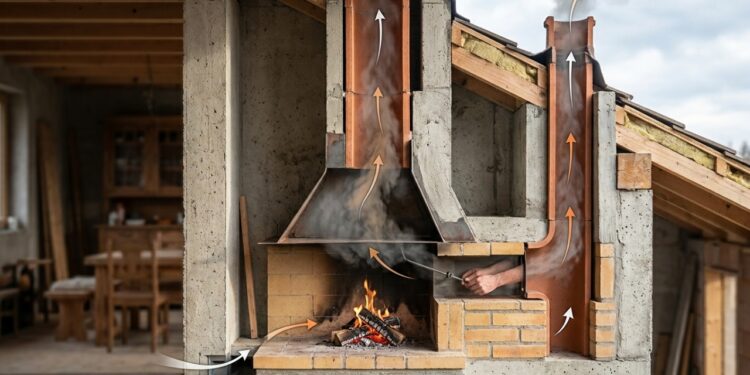
What is chimney draft?
Draft is the movement that carries hot gases and smoke upward and out of the building. In natural draft, this flow occurs mainly due to the temperature and density difference between the internal gases and the outside air. When the system works well, smoke tends to follow the hood and chimney. When it doesn't, smoke can escape through the front opening and enter the room.
Why does chimney height matter so much?
A taller chimney can increase the draft effect because it creates a longer column of hot gases. This favours the pressure difference responsible for pushing the flow upward. However, this doesn't mean increasing the height indefinitely is the solution. Cross-section, temperature, losses from bends, and outlet position all need to be considered in the design.
Four factors that affect draft
Factor | How it affects draft |
Height | A proper vertical column favours the pressure difference that moves gases |
Cross-section | A duct that is too narrow or incompatible limits the volume that can pass |
Bends | Changes in direction increase losses and hinder flow |
Air intake | The room needs to replace the air being drawn out |
How the chimney influences draft
The duct cross-section needs to be compatible with the volume of gases produced. Passages that are too small increase resistance to flow, while excessive dimensions can also impair system performance.
The hood should favour capturing and channelling gases into the chimney. Sharp bends, long horizontal sections, and abrupt reductions increase losses — so a straighter path tends to improve draft.
What points should be evaluated in the design?
The chimney must be analysed as a complete system that starts at the capture area and ends at the external outlet. Changing only one component may not correct the root cause.
Key points to check:
Total chimney height and vertical section length
Internal cross-section compatible with required flow
Hood geometry and transition to the duct
Number and angle of bends
Length of horizontal sections
Air intake for replacing extracted volume
Position of the external outlet relative to roof and obstacles
Maintenance conditions and residue buildup inside
Why is replacement air important?
The chimney needs to remove gases without creating an air deficiency in the room. In sealed spaces, doors, windows, and permanent inlets help compensate for this volume. Exhaust fans running simultaneously can alter internal pressures.
Signs like smoke returning, soot stains, or difficulty maintaining draft indicate the system needs evaluation. Cleaning, duct dimensions, hood, bends, and air intake should all be checked before installing an exhaust fan or modifying the chimney.
How to visualise the correct smoke path
Flow starts at the burn area, passes through the capture zone, reaches the hood, and enters the duct. Each change in cross-section or direction affects the path to the outlet.
Notice how the chimney, hood, and air intake need to function as parts of the same system.
Can external wind interfere with the chimney?
Yes. Roofs, walls, and nearby structures create pressure zones and turbulence around the outlet. Depending on position, wind can either help or hinder discharge.
That's why the height and location of the terminal need to consider the surroundings. Simply changing the top finish doesn't always solve a problem created by the overall geometry.
Why chimney draft must be calculated as a complete system
Chimney draft results from the interaction between height, cross-section, gas temperature, hood, bends, external outlet, and air availability. None of these elements works entirely in isolation.
When smoke frequently returns, the best approach is to investigate the complete path before adding an exhaust fan. A technical assessment can identify constraints and define corrections compatible with the barbecue, fireplace, or installed equipment.
Advertisement
Advertisement
 Promover
 Popular
Advertisement


